


Autor: Przemysław Chwiszczuk

Przemysław Chwiszczuk
Wpisy autora Przemysław Chwiszczuk:
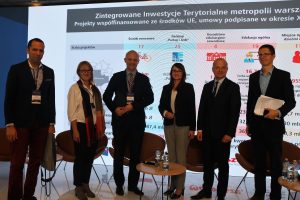
A fascinating description of metropolitan cooperation, impressive data on specific projects, and a multitude of benefits for the residents – these are the highlights of the debate “How does Greater Warsaw work?” organised during the 9th Mazovia Development Forum.

Among the participants were: Ms Renata Kaznowska – Deputy Mayor of Warsaw, Ms Anna Dziama – Education Director of the Copernicus Science Centre, Mr Daniel Putkiewicz – Deputy Mayor of Piaseczno, Mr Piotr Grubek – Deputy Mayor of Kobyłka, and Mr Tamas Dombi – Deputy Director of the Municipal Roads Authority. The debate was led by Maciej Fijałkowski, Director of the European Funds and Development Policy Department.
The discussion panel was divided into thematic blocks: public transport, air protection, education, care for children under 3 years old, and public e-services. The participants discussed the activities of Greater Warsaw under the available EU funds from the Integrated Territorial Investments instrument and other forms of cooperation related to public transport and air protection.
See the video from the debate (starting at 2 hrs 22 min):
The City of Warsaw has updated the WFA ITI 2014-2020+ Strategy. The update is a result of resolutions passed during the 18th meeting of the Steering Committee of the WFA ITI of 12 February 2018 (Resolution No. 20 of the Steering Committee of the WFA ITI on shifting the funds from Submeasure 3.2.1 Economic promotion under the ITI to Submeasure 4.3.2 Urban mobility under the ITI and Resolution No. 21 of the Steering Committee of the WFA ITI on shifting the funds from Submeasure 10.3.3 Educational and occupational counselling under the ITI to Submeasure 10.1.2 General education under the ITI). Furthermore, it was necessary to adjust the provisions of the Strategy for the WFA ITI 2014-2020+ to the programme documents, i.a. changes in the ROP MV 2014-2020.
The Strategy was positively assessed by the Board of the Mazowieckie Voivodeship during the session of 25 September 2018 (Resolution No. 1515/377/18). On 9 October the Ministry of Investment and Development also issued a positive assessment of the document. The text of the assessment is appended to the newsletter.
See the updated document:
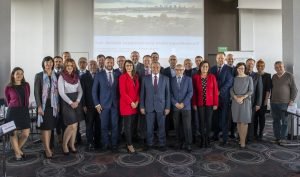
As part of the Integrated Territorial Investments in Greater Warsaw, local authorities have signed agreements for EU funding worth over PLN 550 million. This money will help i.a. provide additional places in nursery schools, bike paths, and P&R facilities.
“We concluded agreements concerning 79 projects with a co-funding amount of almost PLN 540 million. The projects will be implemented individually by communes, in commune partnerships, in partnership with Warsaw authorities and by thriving NGOs and private enterprises operating in the area of Greater Warsaw,” said Renata Kaznowska, Deputy Mayor of Warsaw. “All the activities revolve around one thing: the partnership arising from the covenant of 40 communes signed in February 2014 and common investment strategy.”
Investments of Warsaw and communes around the city are implemented, i.a., thanks to European funds worth over EUR 700 million from the 2014-2020 Mazowieckie Voivodeship Regional Operational Programme as part of the Integrated Territorial Investments instrument. This special pool of European money helps local governments of Greater Warsaw shape vital aspects of life, such as public transport, education, and economic development. These funds also enable closer cooperation between Warsaw and the agglomeration’s communes utilising their potential and assets to the fullest.

The capital city is expanding its cooperation with Greater Warsaw communes in spatial and substantive terms. On 1 January 2018 the Mazowieckie Voivodeship was divided into 2 NUTS2 statistical units. The first was the “Warsaw Capital” NUTS level consisting of more than 70 communes: Warsaw and 9 districts near Warsaw (Grodzisk Mazowiecki, Legionowo, Mińsk Mazowiecki, Nowy Dwór Mazowiecki, Otwock, Piaseczno, Pruszków, West Warsaw, and Wołomin). The internal diversity of Greater Warsaw does not constitute a barrier to the effective joint management of the area but should be regarded as its important asset. “The Strategic action plan for Greater Warsaw – Strategic guide 2.0” will serve as a roadmap for further joint metropolitan activities, identifying Greater Warsaw’s development needs. The leitmotif of the strategic guide is Greater Warsaw in balance.
Greater Warsaw –the benefits for the residents
Municipal transport
The metropolitan cooperation takes the form of the Integrated Ticket, i.e. a special package with which the holders of selected ZTM tickets can take suburban trains in Warsaw and 33 nearby communes. The Integrated Ticket is used by an increasing number of passengers – within the last couple of years there has been a 20% rise. Since 1 September the residents paying taxes in Greater Warsaw’s communes have been able to take advantage of cheaper urban transport tickets in Warsaw, and the holders of the Varsovian’s Card do not pay for trips to the 2nd zone.
Air protection
Air has no boundaries, so Greater Warsaw’s local government bodies are acting together to protect it by subsidising the replacement of coal stoves with more environmentally friendly sources of heat and the installation of equipment using renewable energy sources, e.g. heat pumps and solar systems. They are investing in modern Park & Ride facilities enabling Varsovians to leave their cars and use state-of-the-art urban transport. They are supporting the idea of low emissions by expanding the bike path network used by Greater Warsaw’s residents in the daily commute to work, school or university. Any reduction in the number of cars on the streets contributes to a decrease in pollution and an improved operation of public transport.
Education
Metropolitan cooperation means acquiring EU funds for educational projects, under which the young residents of Greater Warsaw can participate in compensatory educational classes and use modern educational aids. Another important aspect is the development of educational and occupational counselling in primary and lower-secondary schools and strengthening cooperation between schools and businesses.
Care for children under 3 years old
The metropolitan cooperation provides almost 1000 places in nursery schools for the youngest Greater Warsaw residents. With the EU-funded development of infrastructure for the youngest, more parents will be able to take advantage of this form of childcare and return to work seamlessly.
Public e-services
Here metropolitan cooperation means partnership projects for the creation of modern public e-services funded with EU funds. In the near future each resident or tourist visiting Greater Warsaw, with the help of mobile technologies, will be able to use urban transport, the cultural package and public administration services with more ease. The elderly will have an opportunity to use the modern care services support system.

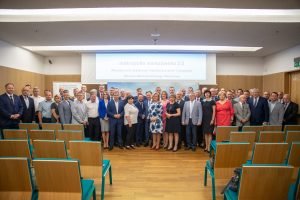
Since 1 January 2018 a new statistical division of the Mazowieckie Voivodeship has been in place, with the Warsaw capital NUTS region encompassing Warsaw and nine surrounding districts with their 69 communes. Since then the Warsaw NUTS 2 level has been regarded as the Warsaw Metropolitan Area. This decision created a necessity to verify the provisions of the Development Strategy for the Warsaw Metropolitan Area written in 2015:
- Does it take into account the current shape of the metropolitan region and the arising needs?
- How do strategic goals of the new communes correspond with its objectives?
- How does the territorial change affect the whole Warsaw Metropolitan Area?
In order to answer the above questions, we have developed “The strategic action plan for Greater Warsaw” in the form of the practical “Strategic guide 2.0” pointing to the development needs of the Warsaw Metropolitan Area within its current borders. The main tool for its development was the organisation of strategic workshops for partners co-creating Greater Warsaw.
Local government bodies are facing a great challenge of building together a harmoniously developing Warsaw Metropolitan Area. The task is undoubtedly difficult, as it requires the reconciliation of their various interests and taking into account differing needs of the respective communes. However, a very important observation arose from the workshops:
The internal diversity of the Warsaw Metropolitan Area does not constitute a barrier to the effective joint management of the area but should be regarded as its important asset.
“The strategic action plan for Greater Warsaw” will be of assistance in making strategic decisions and daily activities keeping Greater Warsaw in balance
The document is available here:



